
Trace Former Morton County Owners Transfer by Transfer
Work backward from the newest recorded conveyance. Start with the current parcel's full legal description and its grantee. Then follow each grantor to the deed by which that person acquired the same land. Morton County's permanent land records reach back to 1886. The official page does not publish how early the online index or its images go, so plan for gaps at the far end of the chain.
| Source | Known horizon | Access point | Historical clue |
|---|---|---|---|
| Online deed index | Earliest online year unpublished | kscountyrecords.com | Grantor, grantee and instrument lead |
| Deed books and indexes | Permanent county records from 1886 | Register of Deeds, Elkhart | Recorded conveyances beyond web coverage |
| Historic plats | Richfield plat documented in 1887 | Kansas Historical Society / recorder | Original lots, blocks and town layout |
| Newspapers and census | Including 1905, 1915 and 1925 census images | Library and archives | Identity context, not title proof |
Let the deed index carry the chain itself. Reserve historical sources for untangling old names, changed localities, or people who share a surname. No timeline is complete until every link matches the same legal description.
Reconstruct the Morton County Deed Chain Backward
Each seller becomes the next search subject. Move from the latest instrument toward the earlier books instead of guessing from a directory name.
- Find the current holder’s acquisition deed with that party as grantee.
- Copy its grantor, deed type, recording date and complete description.
- Search that grantor as an earlier grantee and verify the same tract.
- When web results end, continue in the physical reverse index and deed books.
- Grantor / grantee
- The conveying party and receiving party.
- Chain of title
- The verified sequence of recorded interests.
- Reverse index
- The route used to find when a prior owner acquired the property.
Richfield’s 1887 Plat Bridges Record Eras
Richfield was Morton County's original county seat. KSHS documents an 1887 ATSF plat for the town, and current tax-sale examples on Oak, Walnut, and Highway 27 still use lots in Block 4. The plat explains that block pattern. The KSHS Morton County page supplies the context, but the modern Tax ID and deed description must still confirm the parcel.
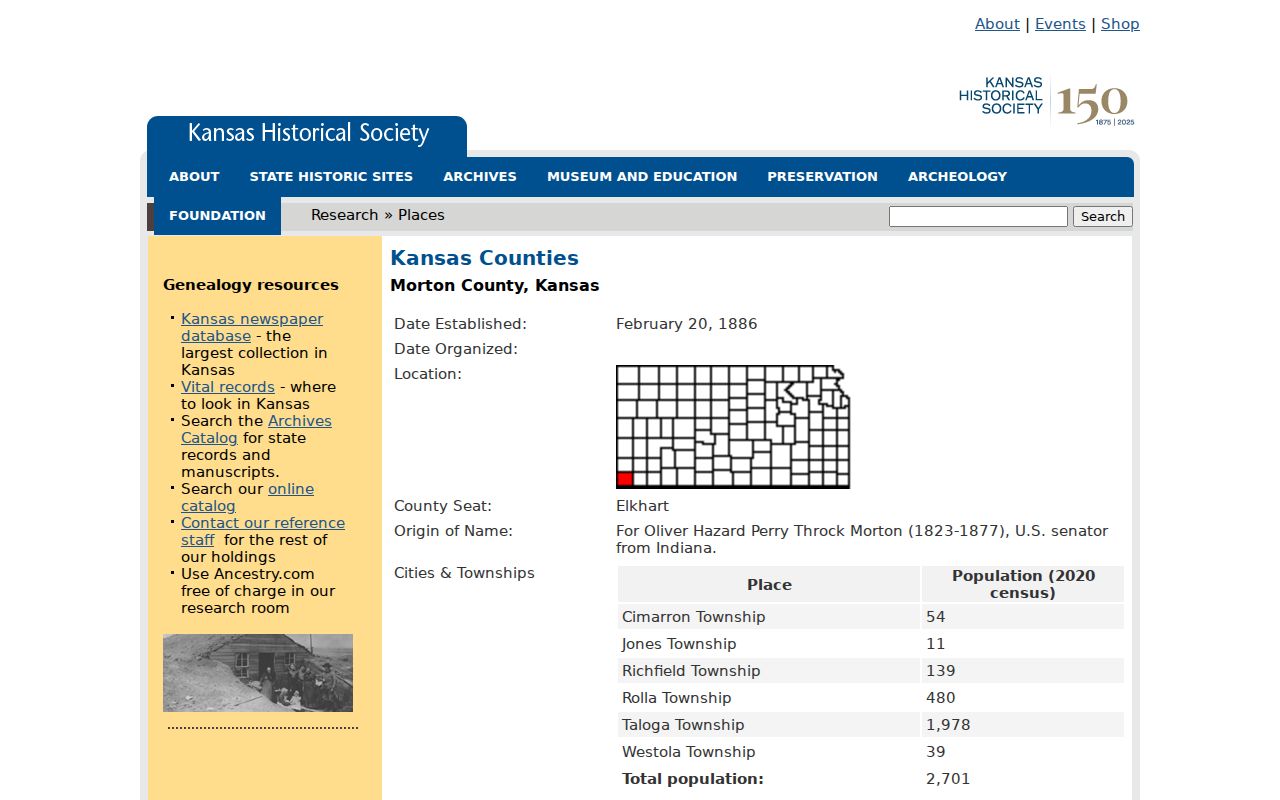
The archive route helps interpret old place names while recorded instruments establish former ownership.
Follow Estate Transfers Through the Court Record
Probate can interrupt a clean deed chain. Search public case events through the Kansas court portal or at the Morton County courthouse terminal. Join what you find to an executor's deed or another recorded instrument. Vital records stay restricted under K.S.A. 65-2422d and are no public owner index.
Use Elkhart Newspapers to Separate Similar Names
The Elkhart Public Library index returns citations leading to Elkhart Truth microfilm and scans. That evidence can separate similar names. No name joins a deed chain without a matching instrument.
Track Description Changes, Not Just Names
A deed chain can stop for description reasons. A larger tract may have been subdivided, or an instrument may cite only a parent legal description rather than the new lots. In town, match subdivision, lot, and block. In rural Morton County, match section, township, and range. Plats show when a new description began; deeds show the conveyance. Rolla's Original Town Lots 11-12, Block 10, and Frazer Subdivision are exact strings that outperform a street address. In Richfield, current tax-sale descriptions can be checked against the 1887 plat, but the result stays a lead until the Tax ID and instrument align.
Mineral interests need their own thread. June 23, 2025 County Commission minutes mention land sales, a sheriff's deed, and minerals. The minutes are not the instruments. Search the meeting date and the parties in deed and court records, then follow any mineral reservation or release apart from the surface chain. A parcel map shows surface geometry. It cannot settle severed-mineral ownership.
Continue Morton County Research Beyond the Courthouse Index
The Kansas Historical Society research room offers microfilm and archive-catalog routes. Its county bibliography identifies newspapers and local-history material for Elkhart, Rolla, and Richfield. FamilySearch catalogs Morton County state-census image groups for 1905, 1915, and 1925. The Morton County Museum holds photographs, newspapers, maps, and files. These collections explain plenty. An obsolete road name can come clear there. So can a former town designation or a family relationship. A similarly named grantor may surface too.
Use them as support, nothing more. A newspaper item about a family moving to a farm proves no legal interest. A census address proves no title either. Once a historical source supplies a spelling, date, or locality, return to the Register of Deeds index. Return to the books as well. There, record the instrument number or book and page. Record the deed type, the parties, and the description too. That loop between context and the recorded chain matters most in one situation. It helps when a historical parcel predates modern street addressing.
How Far Back Morton County Ownership Records Go
The Register of Deeds sets 1886 as the permanent land-record horizon. Its online search starts at an unpublished date. No web result should be called a complete former-owner chain. Older town-company and county-seat-dispute papers explain local history. They never replace recorded deeds.
Coverage limit. When the online trail ends, continue in Morton County’s physical indexes and deed books; never use former-owner information to stalk or harass anyone.
List every unresolved interval before visiting the courthouse. Include the last verified grantee. Include the next known owner and the approximate years. Add the exact subdivision or section-township-range description. Register of Deeds staff do not run searches for requesters, so a tight worksheet keeps the in-person review focused and makes copy requests precise.
Keep two citations when probate, foreclosure, or a sheriff's proceeding supplies a link. The court order shows authority to transfer. The deed records the conveyance itself. Never collapse the two into one date, and never treat a docket entry as the deed.