
Fields in Morton County Property Tax Records
The Morton County Appraiser fixes taxable location, ownership, exemptions, and valuation for each parcel. The Clerk handles levy and roll work. The Treasurer then collects and distributes county, city, school, state, and special-assessment taxes.
| Field | What It Shows | Where |
|---|---|---|
| Appraised value | Estimated fair-market value as of the valuation date | Appraiser |
| Assessed value | Appraised value multiplied by the Kansas class rate | Appraiser / notice |
| Taxing location | Districts whose levies apply | Appraiser and Clerk |
| Mill levy | Rate applied per $1,000 assessed | Clerk / bill |
| Bill and status | Amount, installments, payment, or delinquency | Treasurer |
Three dollar figures get confused constantly. Appraised value, assessed value, and sale price answer different questions. Kansas multiplies appraised value by a class rate to reach assessed value. Taxing authorities then apply mills to that figure. A tax bill is not a statement of current sale price or title.
Morton County's January-to-March Valuation Cycle
Real property is valued as of January 1. Morton County describes annual valuation and a field inspection at least once every four years, using exterior observations, improvements, land characteristics, and comparable sales. Real-property notices are mailed on or before March 1 and show current and prior appraised and assessed values.
This calendar matters because a recent sale may not immediately align with an annual roll. Record the effective year beside every number. The official Appraiser page below supplies valuation contacts and market-study links.
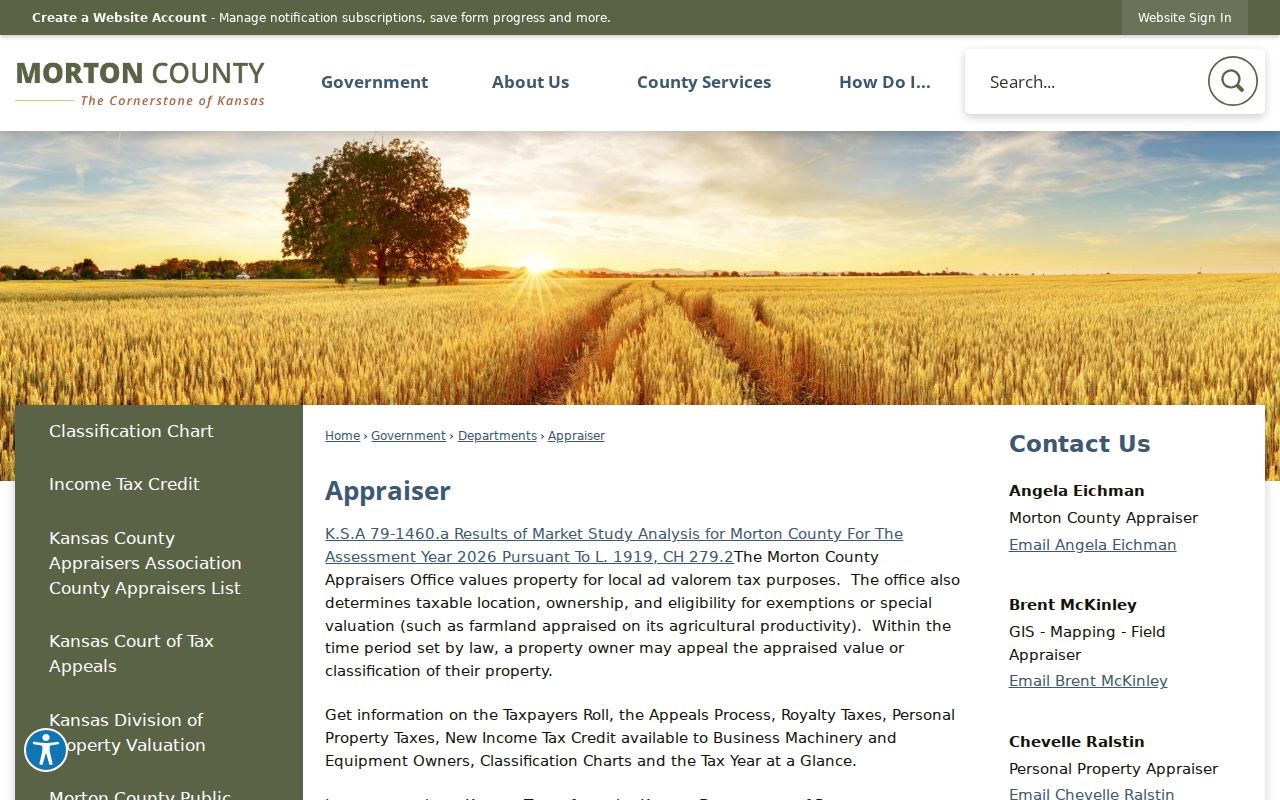
The office page explains the valuation role, but an individual value still needs a parcel result or a notice.
Kansas Class Rates Shape Morton County Assessments
Kansas does not assess every class at the same percentage. State material sets residential property at 11.5%, vacant lots at 12%, agricultural land at 30% of economic-use value, and commercial or industrial property at 25%. Check classification before comparing two tax bills.
| Appraised value | Value before the class rate. |
|---|---|
| Assessed value | Appraised value multiplied by the statutory rate. |
| Mill | One dollar per $1,000 of assessed value. |
| Special assessment | A property charge not necessarily produced by the general mill formula. |
| Tax lien | A claim connected to unpaid taxes, not proven by an old web result alone. |
The Kansas formula applies the class rate first and the mills second.
Look Up a Morton County Tax Bill
The county links to eCountyWorks for tax lookups. Its live fields, coverage, history, and convenience fees may vary, so treat the Treasurer as the authoritative fallback for any Morton County tax bill question.
- Start with the full Tax ID; test the address only if offered.
- Label the bill year, installment, amount, and status exactly.
- Compare valuation and classification with the Appraiser's notice.
- Call the Treasurer at 620-697-2560 for a current balance or delinquency question.
- Tax year
- The year to which a valuation, levy, and bill apply.
- Owner line
- The tax-record name, not independent proof of current title.
- Redemption amount
- A dated figure that can change with costs and later action.
- Payment under protest
- A valuation-dispute route initiated with payment through the Treasurer.
The 2026 Morton County Sale Notice Is a Snapshot
The official notice, published March 12, 19, and 26, 2026, lists Tax ID, owner line, legal description, situs, delinquent years, redemption figure, and sale parcel number. It spans Elkhart, Richfield, and Rolla. Both city lot-and-block and rural legal descriptions appear in it. Remember what the notice is not. It is not a live roll, a complete encumbrance search, or a current title record. The owner line and redemption amount belong to the notice date. Confirm balances with the Treasurer. Confirm ownership through a recorded deed.
Dated evidence. Never infer that later taxes remain delinquent,or have been paid,from the 2026 notice alone.
Read Morton County Tax Deadlines by Date
A March 25, 2026 county alert covered second-half property taxes. The office said payment was due in office or postmarked by May 11. That was a dated deadline notice, not a perpetual rule. Always check the current bill or Treasurer guidance for the dates that apply now. The division of labor stays simple. The Clerk calculates bills from valuation and levy work. The Treasurer collects. A balance or payment question belongs with the Treasurer. A disagreement with appraised value begins with the Appraiser.
Payment Under Protest Follows a Different Path
Morton County says an owner disputing valuation through payment under protest gets a form from the Treasurer. The owner then makes the first-half payment. The hearing concerns value only. This path differs from the timely informal appeal that follows the valuation notice. It is not generic extra time for a missed filing. Bring the notice, Tax ID, property characteristics, photographs, correction evidence, and comparable sales. Comparable-sale information is available during the appeal process, subject to lawful limits.
Appeal a Morton County Assessment on Time
The county's appeal instructions say to contact the Appraiser within 30 days of the valuation notice. An informal meeting comes first. The appraiser explains the value and considers evidence, and further state administrative and judicial review may follow.
Appeal window. File with the Morton County Appraiser within 30 days after the valuation notice. Verify the date printed on the notice.
The official appeal page shown below is the source for the local route.
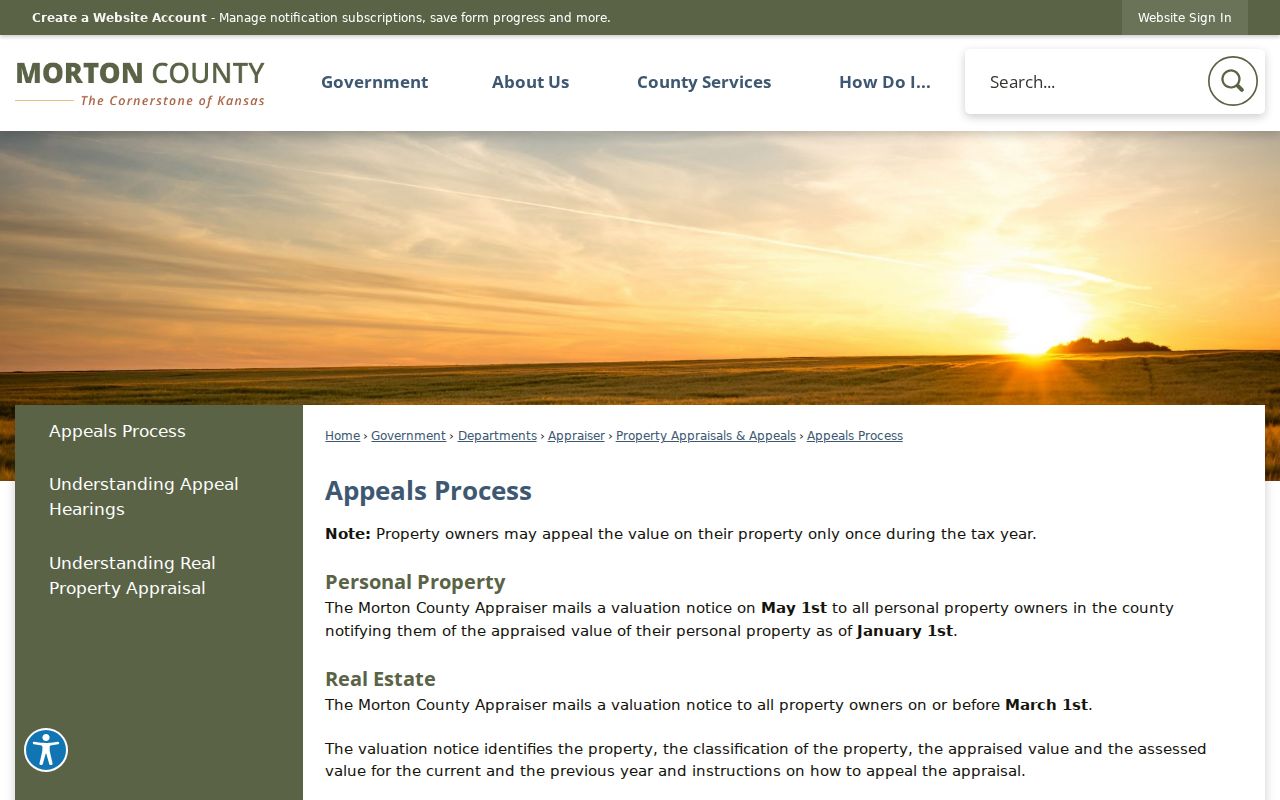
An assessment notice in the mail opens the clock. The individual notice starts the response window, so read it together with your property tax records. Evidence must speak to the January 1 valuation date. Fix an inaccurate property characteristic, document condition, or point to comparable sales that genuinely resemble your parcel. A hopeful list price will not carry the argument. Neither will last year's bill or a neighbor's assessment without explanation. Ask the Appraiser early for the property data and comparables. That gives you time to review everything before the meeting. The Appraiser and Treasurer both sit at 1025 Morton Street in Elkhart, and the Appraiser takes calls at 620-697-2106 while the Treasurer uses 620-697-2560. A written Kansas Open Records Act request can obtain an existing record with a cost estimate, though no office must build a custom report or issue a legal conclusion; name the Tax ID, situs, owner line, tax year, and exact record you want.
Classification disputes deserve the same rigor. Morton County values agricultural land by economic use rather than the market approach applied to most homes, and vacant, residential, and commercial classes each carry different statutory rates. Check both the appraised amount and the class before questioning any arithmetic. If the class is wrong, state that plainly and back it with facts; if the levy is the real problem, name the taxing unit and pull the current mill statement.
Delinquency notices call for careful handling. Preserve the publication dates and every year listed. A redemption figure shifts as costs, interest, payments, and proceedings change. A tax-sale parcel number is only a notice identifier. Never let it quietly replace the parcel's Tax ID or legal description; cross-reference all three before leaning on the entry for purchase due diligence. The same caution applies to payments. Keep your receipt, confirmation number, tender date, account identifier, and tax year separate from the public lookup, then confirm the Treasurer applied the funds to the right parcel and installment. If the online status disagrees, bring those details to the office rather than assuming a search delay moves the deadline or the amount due.