
Compare the Values Attached to Morton County Property
Morton County property value is not one interchangeable number. The Appraiser estimates fair market value as of January 1, Kansas law applies a class assessment rate, the resulting assessed value enters the tax calculation, and a recorded sale supplies a historical transaction clue. Keep the value year and property class beside every figure.
| Value | What It Is | Where |
|---|---|---|
| Appraised value | County mass-appraisal estimate as of January 1 | Appraiser record |
| Assessed value | Appraised value multiplied by the Kansas class rate | Assessment record |
| Sale price | Consideration from a past transaction, when publicly supported | Recorded deed and validated county data |
| Land / improvement split | Components to verify if displayed on the parcel result | Appraiser parcel detail |
Kansas sets the class rates, and they differ sharply. Residential property is assessed at 11.5% of appraised value. Vacant real property sits at 12%. Commercial and industrial property carries 25%, and agricultural land is assessed at 30% of economic-use value. Those rules are exactly why assessed value and a likely sale price should never be compared as if they share one scale.
Morton County Values Property on January 1
The county appraisal guide walks through the January 1 valuation date, exterior inspections, improvement data, and comparable sales. Real property gets a physical review on a four-year cycle. Even so, values can move between visits as market evidence shifts or records get corrected. The parcel's year matters as much as the number itself. For the official value route, open the Morton County Appraiser page.
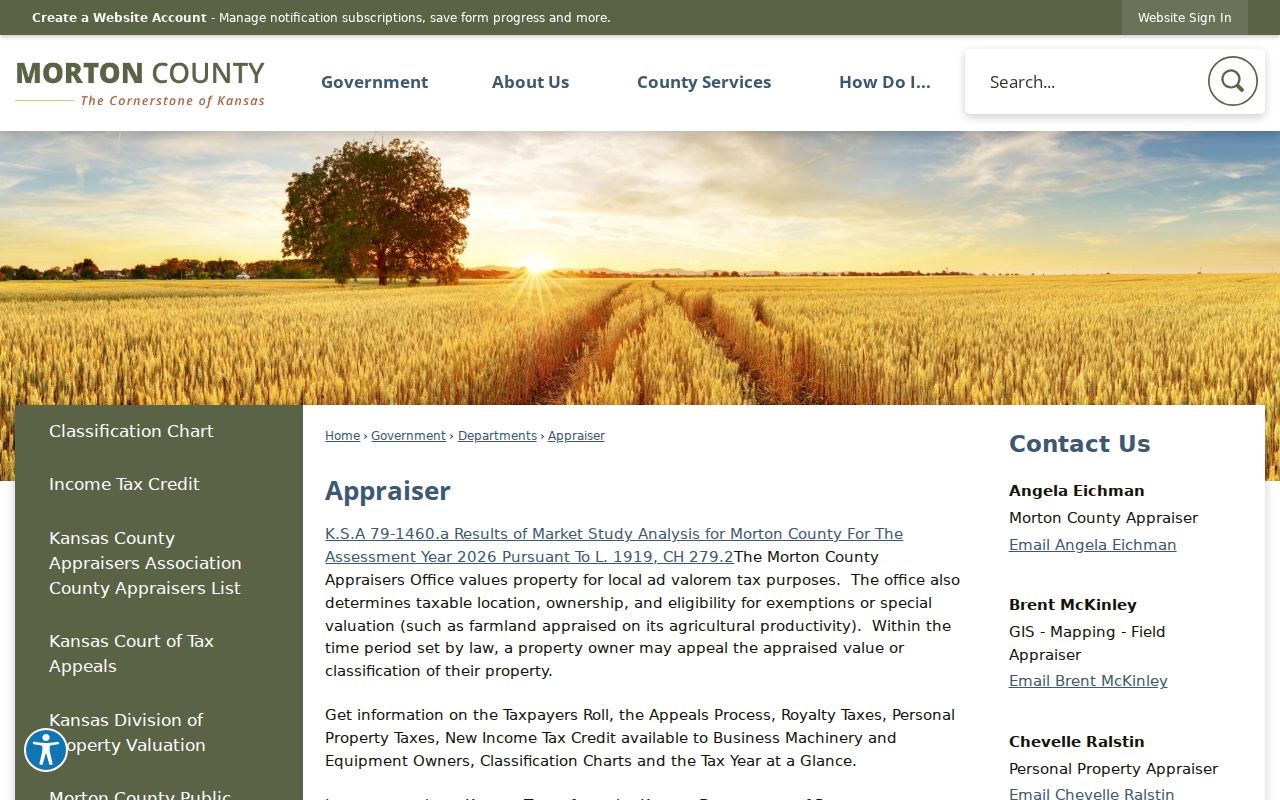
The Appraiser's office page is the authoritative starting point for Morton County valuation records and market-study links.
Kansas Class Rates Change the Meaning of Assessed Value
The Kansas assessment-rate table breaks out residential, vacant, agricultural, and commercial classes. Agricultural land's economic-use value especially bears little resemblance to a conventional sale estimate. Before comparing two Morton County assessed values, identify the classification first.
Estimate Morton County Property Value From Official Records
Start with the parcel. Then place each number in its proper column rather than reaching for the largest or newest figure on the page.
- Select the address in Morton County ORKA and preserve its Tax ID.
- Capture the appraised and assessed values, classification and valuation year actually shown.
- Check the recorded deed for transaction date and any supported sale reference.
- Request comparable-sale information from the Appraiser if reviewing an assessment.
- Assessed value
- The class-adjusted figure used in the tax formula.
- Appraised value
- The county’s mass-appraisal estimate for the valuation date.
- Mill
- One dollar of tax per $1,000 of assessed value.
Read Morton County’s 2024 Market Study Carefully
The county's 2024 market study reported that 2023 residential market values generally increased 0–5%. Vacant property held stable. Commercial and industrial results showed mixed or no discernable trend. That countywide finding does not predict any single parcel. Condition, corrected data, and comparable sales can push an individual value elsewhere.
Challenge a Value Within the Notice Window
The Morton County appeals page lays out a 30-day window after a valuation notice, access to comparable sales, an informal meeting, and later state or court routes. Payment under protest is a separate process from appealing the spring notice. Preserve the notice date and contact the Appraiser promptly rather than trusting a generic calendar date.
Deadline. The 30-day valuation appeal window runs from the notice; use the date on the actual Morton County document.
Separate Value From Morton County’s Tax Formula
Kansas lays out the sequence plainly. Appraised value is multiplied by the applicable assessment rate to produce assessed value. That figure is then multiplied by mills and divided by 1,000 to estimate tax. Special assessments and other account details can still change an actual bill. The math explains why two properties with similar market estimates can carry different assessed values when their classifications differ. It also explains why a higher mill levy raises tax without touching the Appraiser's fair-market estimate. For actual tax balances and payment history, the Treasurer's office at 1025 Morton Street in Elkhart, reachable at 620-697-2560, is the fallback. The county taxing-year guide distinguishes valuation notices, assessed value, mill levies, and payment under protest. Those tax mechanics supply context. The value inquiry itself stays fixed on what each underlying number means.
Compare Like Morton County Properties
A useful comparison controls for classification, location, use, improvements, and valuation year. Residential and vacant land do not share a Kansas assessment rate. Agricultural land runs on economic-use value. Commercial or industrial property sits in another class entirely. Even two residences on the same block can differ. Condition, square footage, outbuildings, or corrected county data can be the cause. Treat the county market study as a broad trend indicator, not a parcel-level adjustment table. A valuation notice may be disputed. The Appraiser's appeal guidance then opens the door to comparable-sale information and an informal review. Ask which characteristics and which sales supported the subject value. Verify every purported comparable is the intended parcel by Tax ID and legal description. A deed's date and consideration can help. A recorded transaction may still include circumstances that set it apart from an ordinary open-market sale. Compare the evidence itself instead of averaging nearby assessed values.
What Morton County Assessed Value Does Not Promise
An assessed value promises little beyond the tax system. It is not an offer or a guaranteed sale price. It is not a title conclusion or a property-condition inspection. It simply serves taxation after the class rate is applied. Buyers and sellers weighing a transaction should compare appropriate market evidence. When needed, they can obtain an independent appraisal.
Value versus price. A Morton County assessment is a mass-appraisal record, not a promise of what a specific property will sell for.
Record the valuation year, property class, and source beside every figure. Without those labels, comparisons across assessment notices, deed transactions, and current market evidence can mislead.