
Read Morton County’s Owner-of-Record Card
Every ownership question in Morton County starts with a parcel. The Kansas ORKA map lets you select a tract and pull its Appraiser record, which ties an owner name to a specific Tax ID and mapped parcel as the roll currently stands. Treat it as an assessment record, not a title certificate. Note every date and identifier you see. Morton County publishes no fixed lag between a closing, deed recording, and an ORKA refresh.
| Owner name | The assessment-roll owner label; capture spelling and entity suffix exactly. |
|---|---|
| Mailing address | Where assessment or tax correspondence goes, which may be outside Morton County. |
| Situs | The physical address assigned to the selected property. |
| Tax ID | The parcel identifier used to reconnect the record to map and tax sources. |
| Legal description | Lot/block/subdivision or rural land description used to verify identity. |
| Sale or deed reference | Use only if actually displayed; verify it in the recorded index. |
Keep perspective on what the card shows. The mailing recipient may not occupy the property. The occupant may not own it. The card is a current lead tied to a parcel. The newest matching recorded conveyance is the confirmation that matters.
Morton County’s January 1 Valuation Clock
The Appraiser values real property as of January 1, and county guidance describes a four-year field-inspection cycle. Valuation notices generally become part of the spring assessment process, but that annual clock is not a promise that an owner name refreshes only once each year. Check the record date, latest deed date and any notice date separately.
A just-recorded deed can be more current than the displayed roll. Conversely, an indexed instrument must match the same legal description before it displaces the owner clue on the parcel card. Date comparison,not an assumed lag,is the reliable Morton County method.
The Official Morton County Appraiser Fallback
If the interactive map isn't an option, go straight to the official Appraiser page and contact the office about the parcel fields you need.
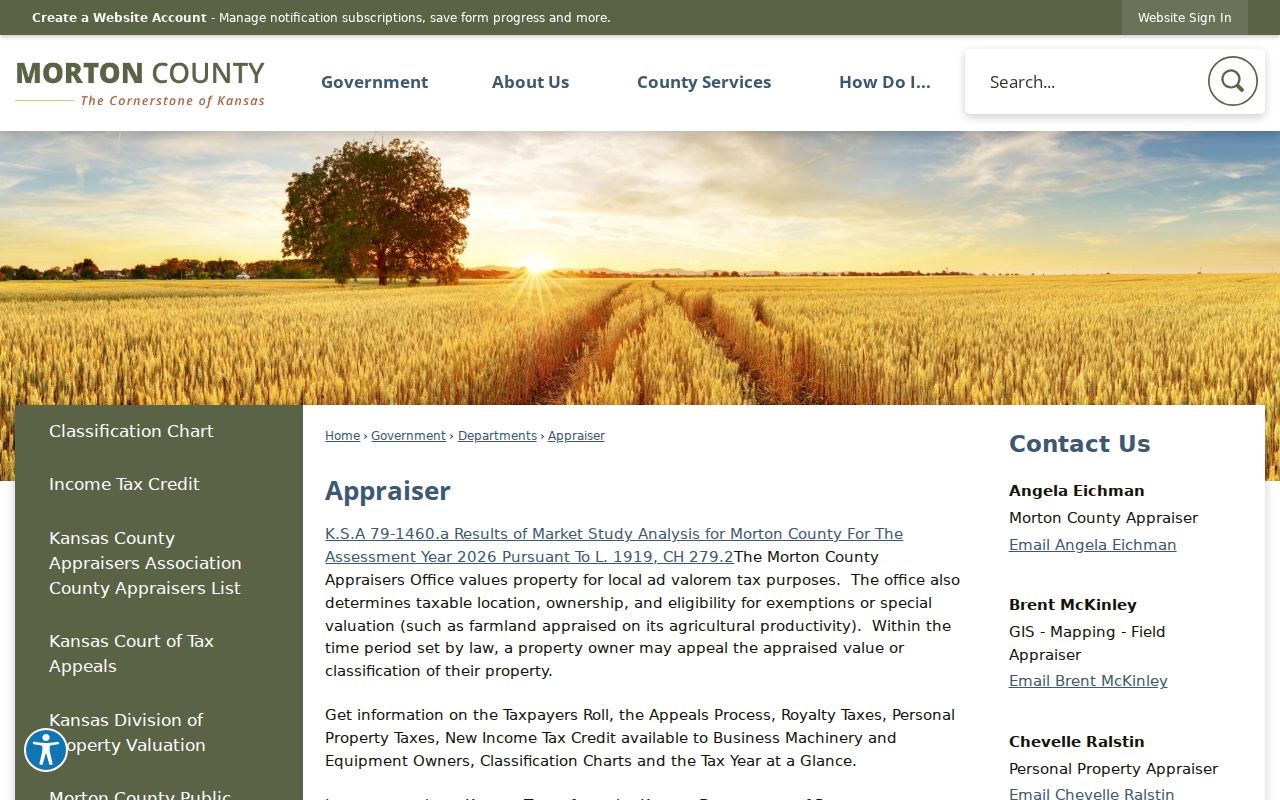
The office page introduces the county's valuation office and its services. It isn't a substitute for pulling the parcel card itself. Ask the staff directly for the ownership fields available for a specific tract.
Confirm Morton County’s Current Owner Against the Deed
Verification means joining the assessment parcel to the latest recorded instrument. Before leaving ORKA, copy the legal description and Tax ID. Then use the assessment owner's exact name as a search lead in the county deed records index.
- Select the parcel in Morton County ORKA and transcribe the current owner line, situs, Tax ID and description.
- Use the online county records search to find the newest conveyance naming that grantee.
- Compare recording date, grantor, grantee and legal description; do not rely on a name match alone.
- If the names or dates conflict, contact the Register of Deeds at 620-697-2561 for inspection access.
- Owner of record
- The party carried as owner on the assessment record.
- Recording lag
- The interval between a recorded change and its appearance in another county system; Morton County publishes no fixed interval.
- Situs
- The parcel’s location, distinct from the owner’s mailing destination.
Check an LLC Name Without Mistaking Its Agent for the Owner
When ORKA lists an LLC or corporation, take the entity name to the Kansas Secretary of State Business Entity Search. The lookup accepts an entity name, an SOS Business ID, or a resident agent, and it caps the results returned. The filing tells you whether the entity is still active and gives an agent contact. That agent is not the parcel owner. Sole proprietorships and DBAs don't appear there at all. Trusts and estates call for different care. Keep the full caption from the owner line. Compare it against the grantee named on the deed. If a death transfer is involved, probate cases may be public through the Kansas court portal, while vital records stay restricted under K.S.A. 65-2422d.
A Tax-Sale Owner Line Is a Dated Morton County Clue
Morton County's March 2026 tax-sale notice pairs owner labels with Tax IDs and legal descriptions. It also lists situs addresses, delinquent years, and redemption amounts. That mix is handy for pinning down a stubborn parcel. Remember what the notice is, though. It's a snapshot of a delinquency process. It is not proof of today's owner or a full title picture. Recheck the parcel roll and the deed index before trusting a notice name as current.
Insider tip. Keep an owner label’s source date beside the name; “current” means little when the evidence dates are hidden.
Compare Dates Before Calling an Owner Current
Morton County's four property systems answer different questions on different clocks. The Appraiser keeps ownership-oriented parcel and valuation data. The Register of Deeds receives conveyances. The Treasurer tracks tax accounts. District Court holds litigation and probate events. A deed's recording date may post before another system catches up. A tax notice may preserve an older account caption. A court filing may only allege an interest. Build a short evidence list showing the source, exact owner caption, date, Tax ID, and legal description for each entry. The newest date wins only in one case. The record must concern the same tract and actually record a transfer. If a parcel card shows no update date, ask the Appraiser what the owner line represents. Do not guess at a refresh cycle. If a conveyance reads ambiguously, inspect the document at the Register of Deeds. The office sits at 1025 Morton Street, Elkhart, and is open for public inspection, though staff won't run searches for requesters. That cross-system discipline is what separates a real current-owner check from a casual name result.
Preserve the Exact Current-Owner Caption
Exact wording carries weight in the deed index. Copy the owner caption from ORKA character for character, including initials, middle names, and trustee phrasing. Only if the exact string fails should you try a controlled variation. Entity suffixes deserve the same care. A search for "ABC LLC" will miss "ABC, L.L.C." on the first pass.
Businesses call for a different path. The Kansas Secretary of State lets you search by entity name. It also searches by SOS Business ID or current resident agent. Two limits apply: results are capped, and sole proprietorships or DBAs never file there. Remember that a registered agent is a statutory contact. It does not prove the agent owns the parcel.
Trusts need their own check. Write down the trustee language. Compare it with the grantee clause in the most recent deed. For an estate, chase the recorded transfer first. Then check a public probate event through Kansas court access if one applies. A mailing-address match alone is never an ownership conclusion. Kansas Safe at Home may substitute a protected address. Other fields like sales-validation questionnaires stay closed. The aim is confirming the current owner of record for the parcel. It is not digging into private households.
Use Morton County Owner Information Lawfully
A public owner mailing address has legitimate uses. It can open a conversation about a purchase, a boundary question, or an estate matter. That address is not proof anyone lives there, though. Kansas Safe at Home protections may substitute an address, military discharges and sales-validation questionnaires remain closed, and K.S.A. 45-230 restricts certain commercial uses of public lists.
Recent-sale caution. The assessment roll can lag a conveyance; the newest matching recorded deed is the stronger current-owner evidence, though neither replaces a title examination.