
What Morton County Deed Records Document
The Morton County Register of Deeds keeps the deeds and the land instruments that travel with them. Document type matters, since each kind of paper transfers, secures, releases, reserves, or maps a different interest in the land.
| Deed Type | What It Does | Common Use |
|---|---|---|
| Warranty deed | Conveys the described interest with stated covenants | Conventional conveyance |
| Quitclaim deed | Conveys whatever interest the grantor has without warranty | Interest cleanup or family transfer |
| Trustee / executor deed | Conveys through an authorized fiduciary | Trust or estate administration |
| Sheriff's / tax deed | Records a transfer from a statutory proceeding | Judicial or tax process |
| Mineral deed | Conveys an interest separate from the surface | Severed-mineral ownership |
Releases, assignments, easements, oil-and-gas leases, and plats belong in the same Morton County deed search whenever they apply, because a mortgage or lien usually secures an interest rather than passing the estate itself. Recording makes a document public. It never guarantees validity or priority.
Morton County Land Records Reach to 1886
Permanent Morton County land records date to 1886. That is the Register of Deeds' stated baseline. The date anchors any deed-record project. Still, it is no promise that every year, index, or image is online, and the county does not publish the contracted portal's earliest searchable year or its complete book inventory.
When an online deed search stops, inspect the books at 1025 Morton Street in Elkhart. For older context, Kansas Historical Society Morton County material includes 1887–1888 county-seat and Taloga Town Company records. Archives suggest names and dates. Only the deed books prove the conveyances themselves.
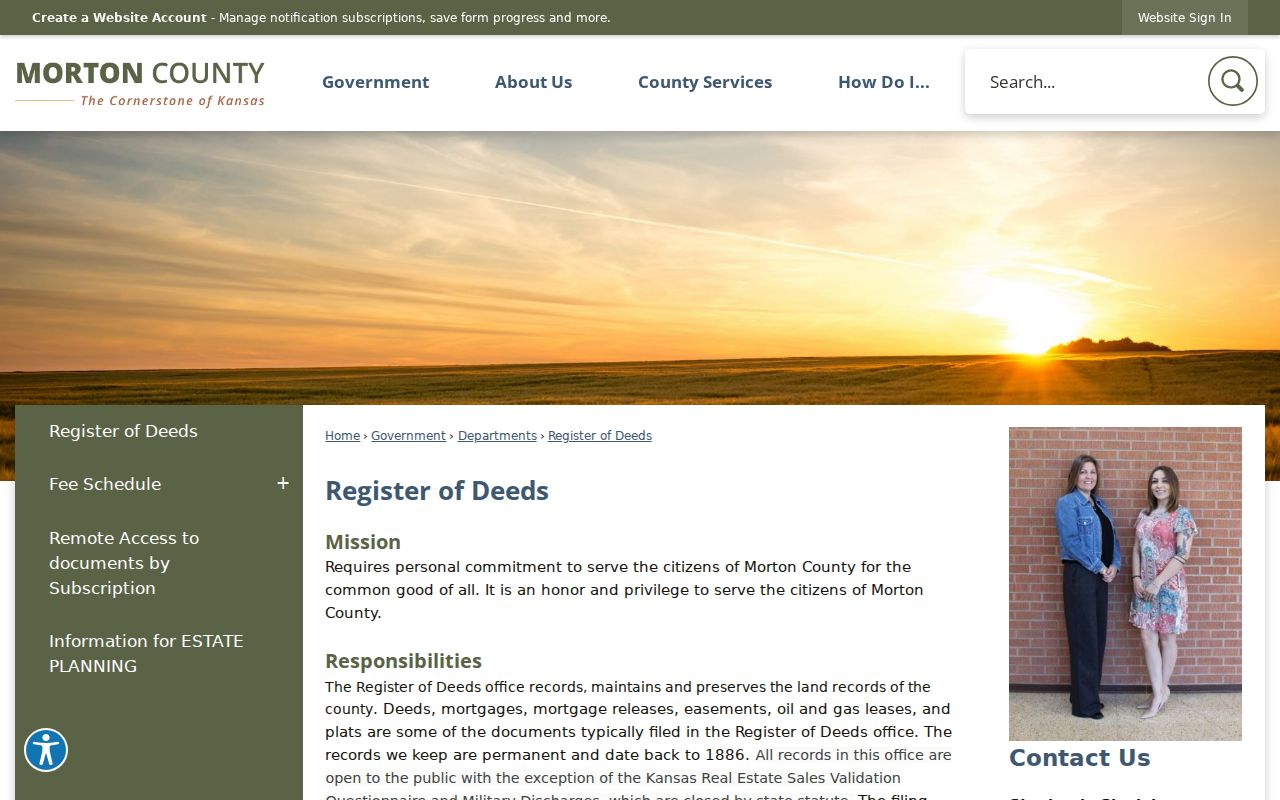
Use the office page for access details, then retrieve the specific indexed instrument.
Use Morton County's Deed Index as a Finding Aid
The county links KS County Records as its online deed index. The landing page is public. A complete Morton County search form is another matter. Expect fields for grantor, grantee, instrument type, recording date, book and page or instrument number, and legal description, but do not assume every field or image is available.
| Index clue | Use | Confirm |
|---|---|---|
| Party name | Search recorded spelling variants | Match the land description |
| Recording date | Narrow a transfer period | Do not confuse with execution date |
| Book/page or instrument | Request one item precisely | Preserve every digit |
| Legal description | Match lot/block or rural land | Read exceptions and reservations |
The captured landing page is an entry point, not proof of a specific result.
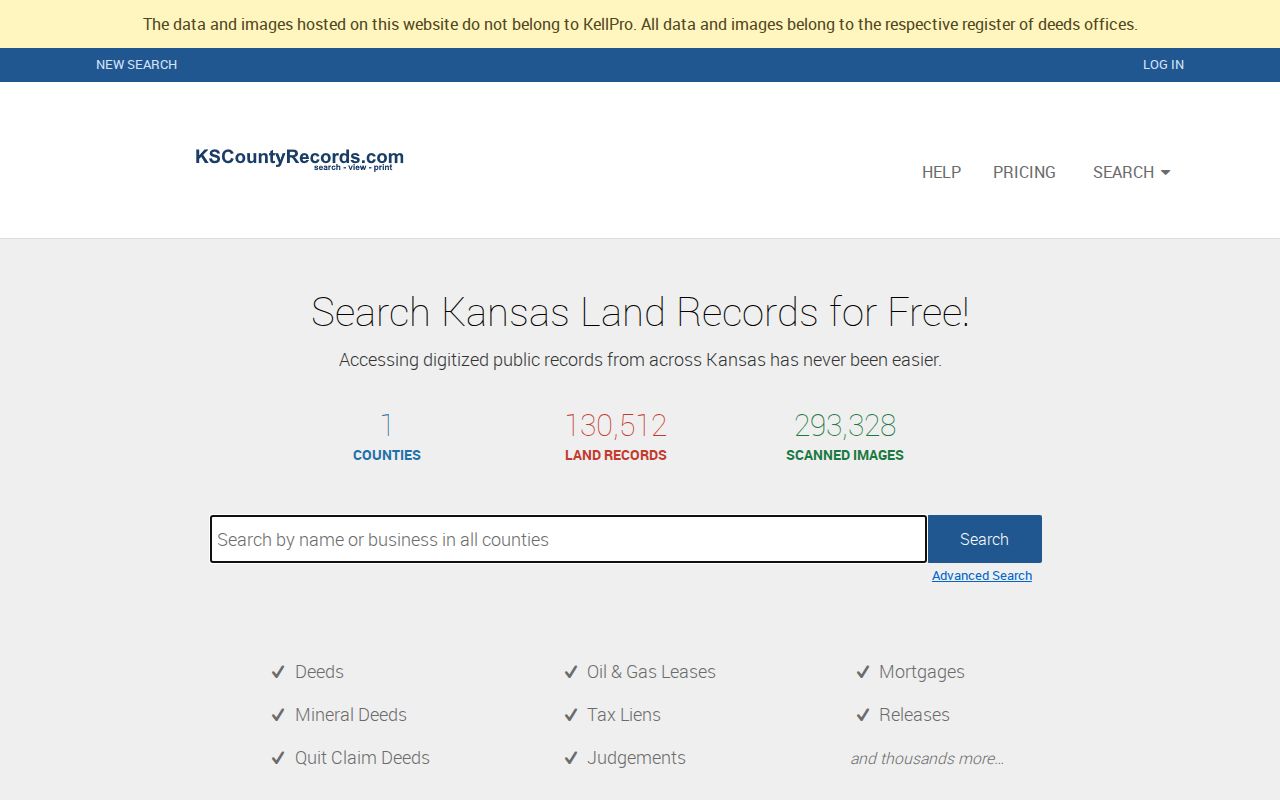
If a form or county selection is unavailable, use the office's public-inspection channel.
Follow Morton County's Grantor-Grantee Trail
Start a backward chain with the latest confirmed grantee. Then reuse each seller's name as a grantee in the earlier search. Keep the legal description constant the whole way, so same-name parties never drag the Morton County chain onto another parcel.
- Find the newest deed for the same legal description.
- Read the grantor, grantee, document type, date, and citation.
- Search that grantor as an earlier grantee and compare land descriptions.
- Repeat until online coverage ends, then continue in office indexes and books.
- Grantor
- The party conveying the stated interest.
- Grantee
- The party receiving the stated interest.
- Chain of title
- The ordered succession of instruments affecting the land.
- Book/page vs instrument number
- Alternative recorder citations used to retrieve a document.
Search Morton County Lots, Blocks, and Rural Tracts
Town lots reward exact strings. Try Rolla Original Town Lots 11–12, Block 10. Frazer Subdivision, Richfield lots and blocks, and Elkhart's Original and First Blocks work the same way. The official 2026 tax-sale notice supplies these as dated clues, not a complete deed chain.
Rural Morton County deeds lean on section, township, range, quarter-quarter, acreage, reservations, and exceptions, so copy that text exactly. Addresses change. Descriptions endure. The recorded description remains the stronger link between instruments, and recorded plats show how larger tracts became named lots and blocks.
Morton County Recording Rules Leave Clues
Every original must be signed, notarized, and legible. Margins leave clues. Paper needs a 1.5-inch top margin, e-recording needs 3 inches, and later pages need one-inch top and bottom margins with half-inch sides. A cover sheet can supply space but counts as a charged page.
A Morton County deed or affidavit of equitable interest requires a Kansas Real Estate Sales Validation Questionnaire or a stated exemption. That questionnaire is closed. The deed stays public. So the validation data and the public deed never share identical access, and e-recording through Simplifile or CSC does not guarantee an instrument's legal effect.
Order a Morton County Deed Copy
You can view an online image when one is available, inspect the record in person, or call the Register of Deeds at 620-697-2561 with an exact citation. The office sits at 1025 Morton Street, PO Box 756, Elkhart, KS 67950, and keeps weekday hours of 9–5, shifting to 9–4 on the last day of each month.
For costs, the fee schedule sets recording at $21 for a first instrument page and $17 for each later page. Certification adds $13. Copies, retrieval, printouts, and staff time are billed separately, so ask for a current estimate and say whether you want a plain or certified copy.
Recorded, not guaranteed. Morton County deed records show accepted instruments, not a title opinion. Unrecorded interests, indexing issues, and priority questions require professional analysis.
Staff at the office will not run a deed search for you. Bring the work to them prepared. Give a party name, a legal description, an approximate date, and either a book and page or an instrument number. The clerk can then pull the exact record instead of guessing. A mailed request should also state how you want the copy delivered. Ask for a fee estimate before anything is processed.
For research you do yourself, a worksheet keeps things honest. Give execution date, recording date, grantor, grantee, instrument type, legal description, and citation their own columns. That separation stops a later deed's recording date from being mistaken for the day possession actually changed. It also helps you catch corrections, re-recordings, and partial releases. It flags instruments that touch only minerals or an easement.
Morton County's public-access exceptions deserve the same careful labeling. Military discharges and Real Estate Sales Validation Questionnaires are closed records. The recorded deed itself is a different animal. An index may list an affidavit or exemption. If no validation form shows up, do not call that a missing deed. Ask the custodian which public instrument can be inspected, then cite only what that public record establishes.
Log your unsuccessful searches too. Track the portal, the county selection, spellings tried, the date range, and the time spent before turning to the office index. A no-result screen may simply mean thin online coverage or an indexing variation. It does not prove no Morton County deed exists. The county's permanent books reach back to 1886.